Most people bring a puppy home and focus on the basics: feeding, sleeping, and toilet training. And that makes sense. But most people overlook one thing, and it has everything to do with how your dog handles the world for the rest of their life. That’s puppy socialisation.
The early weeks of a pup’s life are when the brain is most open to new experiences. What they see, hear, and feel during this time sticks with them for years. If you miss this window, you can spend a long time undoing fear and anxiety down the track.
This is not something pulled from a textbook. At OodlePups, we’ve seen firsthand how much early socialisation changes a dog’s temperament and confidence. That’s why this guide covers exactly what your furry friend needs and when.
The Puppy Development Stages You Need to Know
Puppy socialisation moves through a series of stages, and each one has its own window of opportunity. The stages look simple on paper, but what happens inside each one has a lasting impact. Let’s walk through them.
The Neonatal Stage (0–2 Weeks)
Puppies are born completely dependent on their mother. Their eyes and ears are both sealed shut at birth. At this point, movement is little besides a slow crawl toward warmth, and solid food is nowhere in the picture. Their whole world is smell, touch, and the heat of their mother’s body.
So what does this have to do with socialisation? Quite a bit, actually. Gentle handling from humans during these first two weeks still registers with a young pup.
From what we’ve seen with Pip and Rosie‘s litters, pups that get calm, consistent human contact at this stage tend to settle into new homes more easily. That early handling builds a baseline of trust that carries through.
The Socialisation Window (3–12 Weeks)
This is the stage where a puppy’s brain is genuinely built to take in new experiences. From there, exposure to other dogs, other animals, new people, and different sounds all land in a way that simply won’t happen again later in their development.
Puppies begin interacting with their littermates around this time, too. They also pick up early dog communication skills like reading body language and learning when play biting goes too far. Varied experiences during this window are what build a confident dog.
Worth Noting: Keep an eye on how much you’re throwing at them. Overloading a young pup can do just as much damage as under-exposing them.
The Fear and Growth Period (12–16 Weeks)
Around 12 weeks, puppies hit a phase where new things can genuinely frighten them, so your approach during this period counts for a lot.
Your pup might suddenly hesitate at things they took in their stride just days earlier. That’s the fear phase, and it’s completely normal (first-time owners especially tend to panic here, thinking something has gone wrong).
With that in mind, go slow during this stretch. Based on our experience at Oodle Pups, short, calm introductions work far better than pushing through. Lead walking usually kicks off around 16 weeks, and starting on quiet streets before busier areas gives your furry friend a chance to build confidence gradually.
Believe it or not, behavioural problems that show up later in adult dogs can often be traced straight back to rushed exposure during this exact window.
How Labradoodle Personality Traits Affect Their Socialisation
Not all puppies socialise the same way, and with labradoodles, their natural personality traits can really change how you approach the whole process.

Take the breed’s background for a second. Labradoodles come from Labrador retrievers, crossed with the standard poodle. The combination produces a dog with high energy, a strong social drive, and a genuine eagerness to please.
For the most part, labradoodles love people. They tend to:
- Warm up to strangers quickly
- Get along with other animals without hesitation
- Adapt well to new environments
- Handle new sounds and settings with relatively little anxiety
This natural openness gives labradoodle training a head start that some other breeds simply don’t have.
Still, their curiosity and energy mean training labradoodles works best with structure. Otherwise, free-for-all exposure without guidance can tip a labradoodle puppy into overstimulation pretty fast (Rosie taught us this one the hard way during her first trip to the dog park).
Getting Your Puppy Comfortable With the World Around Them
The more positive experiences a puppy has from the start, the less likely they are to react with fear or aggression later on.
You might be thinking this means taking your pup everywhere and exposing them to everything at once. Not really. In reality, a steady and varied approach beats a loud and overwhelming one every time.
Here’s what a solid puppy socialisation checklist actually looks like in practice:
- People and Places: Introduce your pup to different types of people, including men, women, children, and even people wearing hats or uniforms. Then gradually work up to busier settings like footpaths, car rides, and local parks. Think grass, gravel, tiles, and timber floors. Each new surface teaches you pup that unfamiliar ground is nothing to worry about.
- Other Animals: Meetings with other dogs work best on neutral ground before you attempt dog parks. For cats and other pets at home, keep early introductions short and let both animals set the pace. You should also watch their body language closely here. If you see any signs of stress on either side, separate them quietly and try again another day with a shorter session.
- Crate Training: A crate gives your furry friend a familiar, safe space that goes with them wherever they are. That’s why we recommend building positive associations from the very first session.
One thing that catches a lot of owners off guard: vaccinations. Most puppies don’t complete their vaccinations until around 16 weeks, which limits where you can safely take them. Your vet can advise on low-risk socialisation options in the meantime.
After covering the practical side of socialisation, it’s worth asking whether structured classes add anything on top of that.
Is Puppy School Worth It for Behavioural Development?
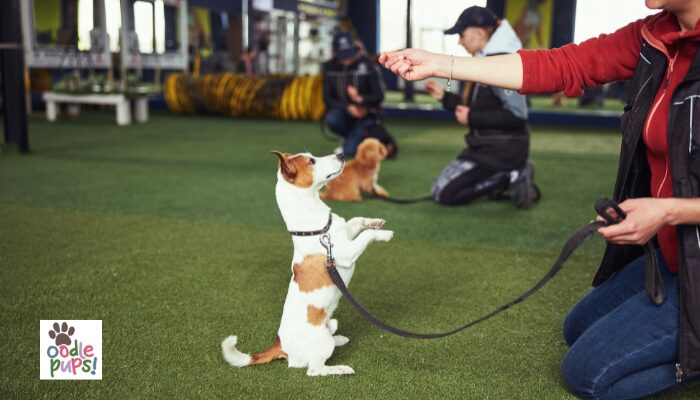
For most puppies, yes. Puppy school is one of the most practical things you can do in that first stretch of development.
Structured group classes give them regular, guided contact with unfamiliar dogs and people, and that repetition is what actually builds lasting social confidence. In class, food rewards and positive reinforcement keep sessions engaging and stress-free. Plus, the mental stimulation alone tends to wear a puppy out in the best possible way (no more bouncing off the walls come bedtime).
Beyond that, dog trainers can spot early signs of behavioural issues, like a tucked tail, a stiff body, or a pup that consistently hides behind your legs. If you brush these off early, you will find yourself dealing with a far deeper issue.
And your vet will probably tell you the same. After all, most vets recommend starting school as soon as your pup is fully vaccinated.
You’ve Got This, and Your Pup Will Thank You
Now that you know what goes into good socialisation, the real work is just showing up consistently. You don’t need a perfect plan or a packed schedule.
At the end of the day, raising a well-rounded dog comes down to patience and small, steady effort. None of it feels dramatic in the moment, but calm introductions and regular training are what build a confident adult dog. Honestly, behind every relaxed, easy-going dog is an owner who put the work in during those first few months.
If you’re looking for a labradoodle puppy that comes with a solid socialisation foundation built in from birth, the team at Oodle Pups breeds with exactly that in mind. We send Pip and Rosie‘s pups out well-handled, well-socialised, and ready to become confident family members.